Use Voice Analysis for Alzheimer's Disease Screening
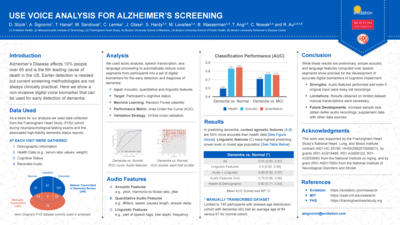
This poster by Alessio Signorini presents early evidence that voice analysis can be used as a non-invasive screening tool for Alzheimer’s disease and dementia. The work addresses a real clinical gap: current cognitive screening methods are time-consuming, episodic, and not always practical for early detection, despite the high prevalence and impact of dementia in older adults .
The study is based on data from the Framingham Heart Study, where recorded speech from neuropsychological exams was analyzed alongside well-characterized cognitive diagnoses. Using a combination of acoustic features (e.g., pitch, jitter, harmonic-to-noise ratio), quantitative speech measures (pauses, fillers, speech rate), and linguistic features (syntax and language complexity), machine-learning models were trained to distinguish normal cognition from MCI and dementia. Linguistic features in particular showed strong discriminative power, with AUC values around 0.9 for dementia vs. normal cognition, outperforming traditional health and demographic variables.
Clinically, the most interesting aspect is that these digital voice biomarkers worked even on older, lower-quality recordings, suggesting robustness and potential for real-world deployment. The authors were clear about limitations, including small sample size and age imbalance, but outlined a path toward larger datasets and fully automated transcription. Overall, this approach appears promising as a low-cost, scalable screening or monitoring tool to complement—not replace—standard cognitive assessments, especially for earlier detection and longitudinal follow-up in at-risk populations.